Understand what communicates before planning network changes.
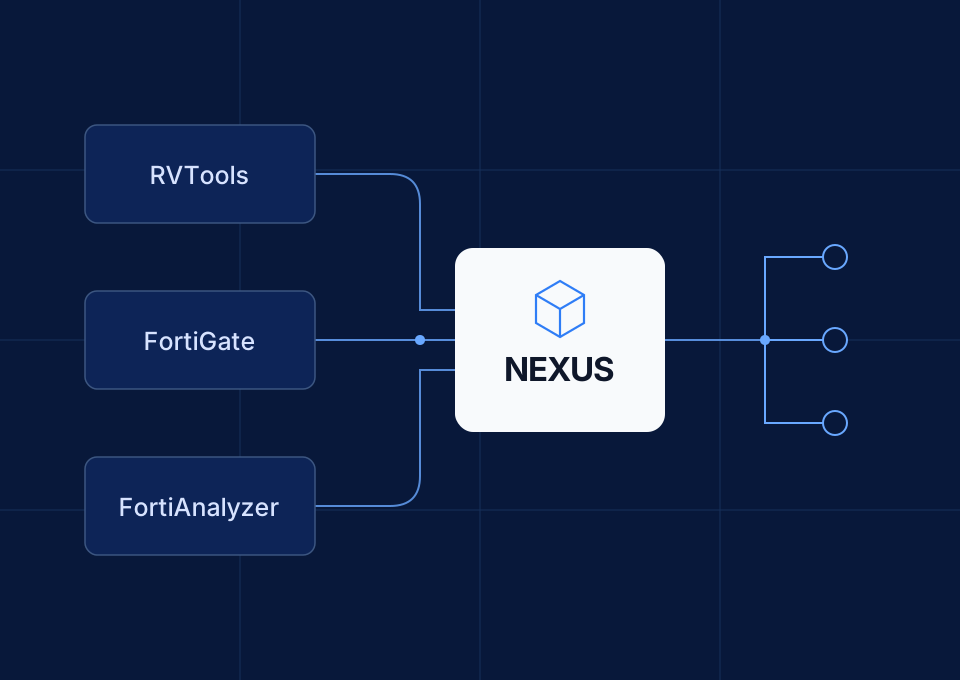
Nexus is a mapping and investigation tool for infrastructure architects and network administrators. It brings together inventories, firewall configurations and logs to identify equipment, examine communications and assess application context.
From scattered data to a shared view of the IT landscape.
NEXUS
Mission reference
Nexus
Nice · Product design and project management
Independent project · Infrastructure and cybersecurity
My role and scope
Position
Nexus product designer and project lead
Period
Independent project in development
Scope
Infrastructure mapping, network investigation and change preparation
3
technical source families
RVTools inventory, FortiGate configurations and FortiAnalyzer / syslog logs.
6
documented product workflows
Search, context, configuration, communications, discrepancies and export.
Read-only
access to FortiGate configurations
Nexus does not modify firewall rules.
My responsibility
I own the requirements, data model, user workflows and development priorities. I assess imports and reconciliation against architects’ and network administrators’ questions: identify an IP, find an asset, examine its communications and assess information before making a decision.
My stakeholders
Infrastructure architects
Network administrators
Security and operations
Mission geography
Location and scope
Nice
Design and management base for the independent project.
Organisation
My role in the team
User needsRequirements from architects, network administrators and security teams
Objectives and decisions
Aurèle SoyezNexus product designer and project leadDesign and management of an independent project
Product workstreams
Repository and data model
Assets, applications, interfaces, networks and responsibilities.
Sources and collection
Inventories, firewall configurations and logs.
Investigation and assessment
Communications, provenance, reconciliation and exports.
Project organisation by product workstream.
Mission portfolio
Projects and workstreams
Each project explains the need, my responsibility, the work managed and the deliverables.
Infrastructure repository and application context
Connect assets and their addresses with known applications, dependencies and contacts.
RVToolsReactFastAPI
Tasks and deliverables : Infrastructure repository and application context
My responsibility
I define the data model, association rules and browsing workflows.
Work managed
Start from technical inventory and network interfaces.
Distinguish identified assets from merely observed addresses.
Preserve explicit associations and expose missing information.
Deliverables
Data model and repository
Asset records and search
Source collection and reconciliation
Bring together inventory, network configuration and observed activity without conflating their meaning.
FortiGateFortiAnalyzerSyslog
Tasks and deliverables : Source collection and reconciliation
My responsibility
I define acquisition, provenance and reconciliation conditions.
Work managed
Use FortiGate configurations via file or read-only API.
Integrate FortiAnalyzer / syslog logs.
Preserve source, time-period and matching context.
Deliverables
Imports and collection
Provenance and reconciliation rules
Network investigation and decision preparation
Start from an IP to understand communications and prepare a firewall review or migration.
SQLAlchemyCSVMapping
Tasks and deliverables : Network investigation and decision preparation
My responsibility
I design analysis workflows, discrepancy presentation and working outputs.
Work managed
Explore observed relationships and configuration context.
Distinguish declared flows, observations and firewall rules.
Export inventories and matrices for further assessment with teams.
Deliverables
Investigation workflows
CSV exports and review materials
The operational need
A simple request. Information to piece together.
A migration is planned, a network zone needs segmentation or a firewall rule needs review. The first challenge is understanding the service involved and its dependencies.
What is behind this IP? Which application uses this server? What does it communicate with? Who can confirm why this flow is needed? The answers lie in the inventory, network configuration, logs and team knowledge.
The frustration comes from having to repeat this reconstruction for each request: cross-check sources, find the right contact and separate facts from assumptions before preparing a change.
Infrastructure architect
Plan a migration with incomplete dependency information.
The VM inventory does not always show which services the machines support, what they communicate with or who can approve a move. Files need to be cross-checked and several teams consulted.
Network administrator
Connect an IP address and a filtering rule to an actual use case.
A request arrives with an address or a server name. The equipment, its network, the relevant rules and the application owner still need to be identified before the change can be prepared.
Security and operations
Understand why access is permitted before changing it.
A configured rule shows what is permitted. A log records activity over a period. A decision also requires an assessment of the need, dependencies and missing information.
The tool in practice
Start with infrastructure, add application context.
An investigation can start with a device or an IP address, even when application mapping is incomplete. Nexus brings technical information and known relationships into a shared workspace.
01
Find a device
Search for a component by name, hostname or IP address; filter the inventory and open its record to view technical information and known associations.
02
Reconstruct the application context
Link components to known applications, dependencies and recorded contacts. Identify equipment awaiting association and information that needs to be completed.
03
Read the firewall configuration
Review FortiGate interfaces, VLANs, zones, objects, services and rules in one place, using a configuration file or read-only API acquisition.
04
Explore observed communications
Start with an IP address or a component to examine exchanges in the collected logs and the equipment communicating with it.
05
Assess discrepancies
Examine declared and observed flows, then compare them with the available filtering context. Sources, time periods and matches need to be verified before drawing conclusions.
06
Share a working baseline
Export inventories, flows and matrices as CSV files to prepare a technical review, document a request or continue the assessment with other teams.
Distinct objects, relationships to verify
A VMware port group, a VLAN and a firewall zone are different objects. Nexus preserves these distinctions when examining matches. Likewise, a VM name is not enough to infer its application: known associations enrich the analysis, while the others still need assessment.
My contribution
From an operational problem to a product.
I lead functional scoping, use-case definition, prioritisation and the development roadmap for Nexus.
This project brings together infrastructure knowledge, data modelling, user-workflow design and progressive feature validation.
01
Define the need
Start with the questions infrastructure and security teams face: which equipment, applications and flows are involved, and what information still needs clarification?
02
Design the repository
Define relationships between applications, components, networks and observations while preserving the origin of the information.
03
Prioritise development
Build a phased roadmap: inventory, imports, collection and reconciliation, followed by improvements to analysis workflows.
04
Validate against the data
Prepare verification scenarios, examine inconsistencies and improve the product based on the limitations encountered.
The solution
A shared repository with identifiable sources.
Nexus brings applications, technical components and network flows into a shared repository. Imports and collection supply information for subsequent reconciliation and review.
RVTools
Technical inventory
Import virtual machines and their network information to populate the component repository.
FortiGate
Network configuration
Use firewall configurations: interfaces, VLANs, zones, objects and filtering policies.
FortiAnalyzer / syslog
Observed activity
Ingest logs through file imports or syslog reception to document observed communications.
Applications · Components · Flows
Find information, examine its relationships and trace it back to its source.
A practical example
Can this rule be changed without disrupting a service?
Educational example · Fictional data
The starting point is an IP address in a change request. The workflow is to recover its context, examine available communications and organise the assessment before a decision is made.
01
Identify
Search for the address, find the inventoried component and examine the available network and application information.
02
Observe
Examine the collected communications and their time period, then review the firewall configuration context.
03
Assess
Distinguish the declared need, the configured permission and the observed activity; have missing associations or ownership details completed.
04
Prepare the change
Assemble a review baseline for a decision with the relevant owners, then prepare approval and testing of the change.
Illustration of the reconciliation process; this table contains fictional data and is not an application screenshot.
Source
Available information
What to verify
RVTools
SRV-APP-01Inventoried address: 10.20.10.15
Confirm the application association and its owner.
FortiGate
VLAN 120 · port2.120Network context and filtering policies
Verify the match between the interface, the network and the equipment.
FortiAnalyzer
10.20.10.15 → 10.20.20.30:443Communication recorded in the logs
Retain the observation period and assess the business need.
The decision to prepare
Does this communication serve an identified need, and what checks are required before changing the filtering policy?
Design decisions
Useful analysis must remain explainable.
01
Preserve the sources
An inventory record, a configured rule and a network event provide different evidence. Their origins must remain clear.
02
Make ambiguity visible
An uncertain match must remain open to review. An assumed correspondence does not automatically become a fact.
03
Keep people in control
The tool supports analysis. Assessing the need and deciding whether to change a rule remain the responsibility of the people accountable.
A flow missing from the logs is not enough to conclude that it is unnecessary: the observation period and scope are part of the analysis.
Progress and roadmap
A working foundation, validated progressively.
Nexus is an application in development, with a shared repository, technical imports and log collection. Reconciliation and analysis workflows continue to be refined.
What this project demonstrates
The ability to translate an infrastructure and cybersecurity need into a data model, user workflows and a development roadmap.
It makes my work between technology and project leadership tangible: defining the problem, prioritising needs, verifying data and preparing a clear decision.
Implementation environment
The application combines a React / TypeScript interface, a FastAPI API and a SQLAlchemy data model. Work covers imports, syslog reception, data provenance and reconciliation between inventory, activity and network configuration.
Independent project in development. Operational benefits remain to be measured against validated use cases.
From knowledge to decisions
Does your IT mapping support decisions?
Let’s discuss your mapping, segmentation or infrastructure and cybersecurity transformation needs.